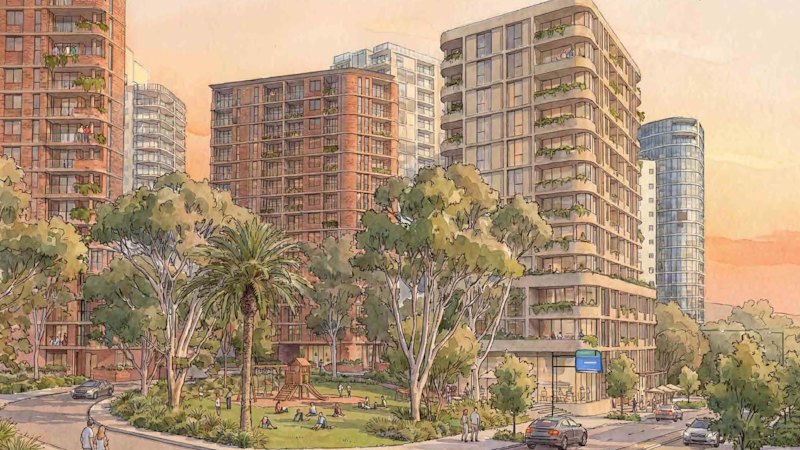
About 3000 new homes would be built around a revamped Oxford Street Mall, under a Sydney council’s plan to lock in Bondi Junction as the civic and commercial heart of the eastern suburbs.
Waverley Council wants to transform the suburb from a transport interchange and retail destination, dominated by the Westfield shopping centre, into a thriving residential, business and late-night hub.
Mayor Will Nemesh said the 20-year plan would concentrate high-rise residential development around the mall and allow for mid-rise housing along West Oxford Street and Bronte Road.
“This plan is about more than buildings and streetscapes: it is about creating a vibrant, accessible, and welcoming place that supports people, business, and community life,” Nemesh said.
Councillors are expected to vote for the “Bondi Beyond” masterplan to go on public exhibition at a meeting on Tuesday night, after the council sought feedback on its draft vision statement last year.
Plans to increase housing density have split opinion among councils and residents in Sydney’s east. Neighbouring Woollahra Council is opposing the NSW government’s plans to build 10,000 new apartments above Edgecliff train station, and around a revived station at Woollahra.
Waverley Council plans to deliver the 3000 new homes – 10 per cent of which would be so-called “affordable housing” for low-income earners – through mid- and high-rise apartment buildings, shop-top developments, terraces, duplexes and houses. Towers would be “slim and well-separated”.
The homes will be spread across five growth areas. The bulk, about 1250 dwellings, would be delivered in Oxford Street Mall, and another 550 would be built in the civic precinct on Ebley Street.
Another 650 homes would be built in towers up to 60 metres around the intersection of Oxford Street Mall and Bondi Road; 350 homes would be developed in mid-rise projects along Bronte Road, and West Oxford Street’s shopping strip would get 150 extra homes.
The council is required to deliver 2400 new dwellings by mid-2029, to contribute to the NSW government’s target to deliver 377,000 homes in that period under the National Housing Accord.
Significant progress towards that target was already being made, the council said, with much of this target tied to projects already in the development pipeline.
The report noted the state government’s low- to mid-rise housing policy, which encourages duplexes and small unit blocks within 800 metres of the station, and the Housing Delivery Authority, which fast-tracks major apartment projects, were encouraging more intensive residential development.
The council said its plan to guide development for the next two decades was “a strategic plan-led approach … compared to blanket upzonings or speculative and ad hoc state-assessed proposals”.
“This approach produces place-based outcomes where tall buildings can occur in areas of least impact, and a human scale can be maintained in centres like West Oxford Street and Bronte Road.
“Criticially, a master plan creates genuine development certainty while producing place-based outcomes such as activated streets, design quality, solar access, deep soil and canopy standards that make Bondi Junction a place people want to live in, not merely a place where density is permitted.
The council report said staff anticipated the plan, once adopted, would ensure proposals submitted to the Housing Delivery Authority, which bypasses local council processes, would no longer be declared for Bondi Junction.
“In the absence of the master plan, the counterfactual isn’t less housing development.
“The reality is that the future of our key places – our centres and neighbourhoods – are determined by arbitrary state-led planning frameworks, regardless of site characteristics, infrastructure capacity or place context. This would lead to diminished place-outcomes for Bondi Junction.”
The plan said Bondi Junction faced challenges, although it was an established transport and retail hub. The streets were fragmented, uninviting, and dominated by traffic and hard infrastructure; the links between the station, Westfield shopping centre, and mall were confusing and disjointed; and the area was too quiet after dark, with few places for people to socialise.
The council aims to deliver 9000 square metres of public open space, including a major new civic square at the station entrance, and has a 35 per cent tree canopy target.
“Bondi Junction’s future will be driven by steady demand for diverse housing and health services, alongside shifts in office use and growing expectations for a stronger night-time economy,” the report said.
“Rising construction costs underline the need for planning settings that balance feasibility with ambition, ensuring Bondi Junction continues to attract investment and deliver a vibrant, mixed-use destination.”
Start the day with a summary of the day’s most important and interesting stories, analysis and insights. Sign up for our Morning Edition newsletter.