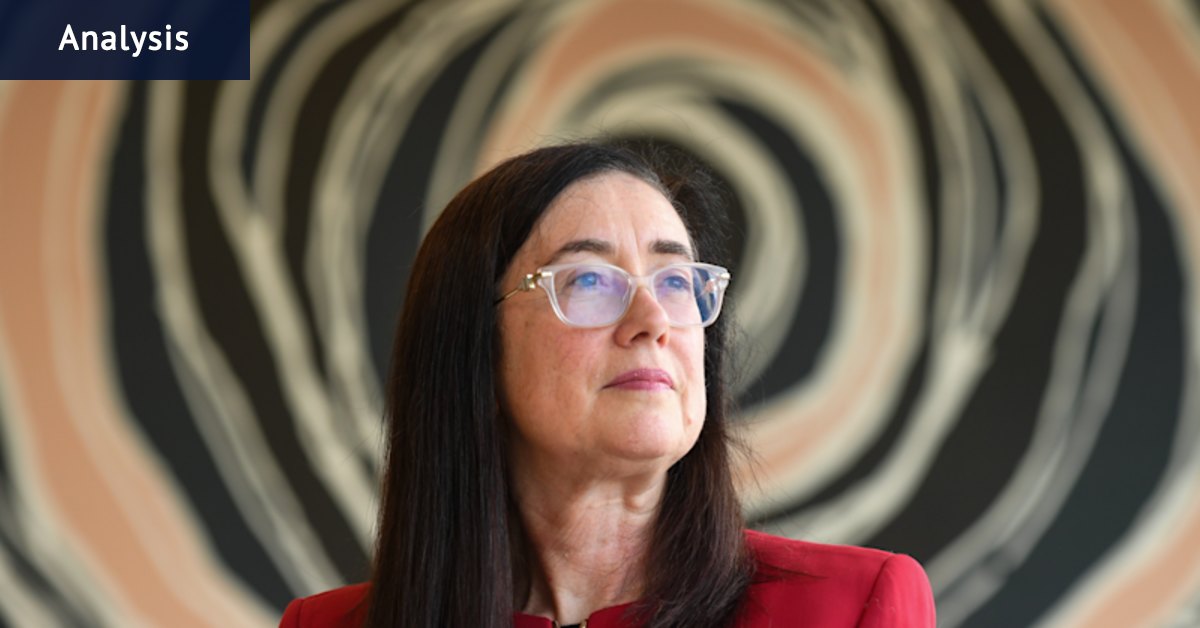
Many Australians, Kevin Rudd pronounced in 2021, were worried the Morrison government had appointed Gina Cass-Gottlieb to run the Australian Competition and Consumer Commission. Rudd charged the competition solicitor with being “a long-serving Murdoch family associate”. She was a “former personal lawyer to Lachlan Murdoch”, Rudd noted, and she had been a director of Murdoch family’s corporate trustee, Cruden Financial Services.
“Her close association with the Murdochs will cause many Australians legitimate concern, given the Murdoch family’s concentration of Australian media power is unmatched in the democratic world,” said Rudd, then at the peak of his post-prime ministerial anti-Murdoch activism.
The implication was that she was some kind of patsy for the corporate world. It has not aged well.
As a partner at major law firm Gilbert + Tobin, who was repeatedly ranked the best competition lawyer in the country, Cass-Gottlieb had no shortage of corporate clients alongside the younger Murdoch. Over the years, she acted for Tabcorp, Wesfarmers, Westpac, Woolworths, Telstra and the Australian Banking Association among many others.
Those former clients are now the kinds of firms she has held to account, winning landmark case after landmark case.
In 2024, Qantas agreed to settle the ACCC’s case alleging it sold tickets on thousands of “ghost flights” it had already cancelled for $120 million in penalties and compensation. On Thursday, Federal Court Justice Michael O’Bryan ruled that Coles (once owned by Wesfarmers) had misled millions of customers by claiming products were “Down Down” when the “specials” were on prices that had been jacked up for a month, leaving the “discounted” items costing more than they had weeks earlier. The ACCC is awaiting a ruling in its similar case against Woolworths.
Danny Gilbert, co-founder and chairman of Gilbert + Tobin, presents Cass-Gottlieb’s role reversal as utterly natural for a woman he has known for decades.
“The dictates of the [ACCC’s governing] act will inform what she does, and she’ll do it to the fullest, just as she acted for clients consistent with their objectives as well,” Gilbert says. “There’s really very little difference. People want to suggest there’s some different modality … I don’t think there is.”
But for all the talk in legal circles of barristers and solicitors acting as simple servants of the court, available for hire by any interested party, the reality is often different. There is no shortage of lawyers who work only for unions, or only for employers; only for the tax office, or only for wealthy families. When a white-collar professional switches sides, the results can be less than ideal. In an extreme example, tax experts from PwC who had been brought in to help the government draft laws cracking down on multinationals shifting profits offshore in the 2010s used the information to drum up business from big corporates.
When pressed, Gilbert allows that Cass-Gottlieb has a strong sense of duty, “a good social conscience” and that she is a progressive thinker. Did she take a major pay cut to take on the ACCC role (it comes with a not-insubstantial salary package worth about $880,000 a year but it is still far less than some top corporate lawyers make)? “I wouldn’t want to comment on that,” Gilbert says. Josh Frydenberg, the treasurer who appointed her and who is now chairman of Goldman Sachs Australia, won’t talk either.
One thing that isn’t driving Cass-Gottlieb is ego. Her spokeswoman would not make her available for interview, noting the ACCC’s litigation against Coles has not finished (penalties are still to be determined, as is potential compensation in a related class action) and nor has the similar case against Woolworths. But asked whether Coles chief executive Leah Weckert should apologise in light of this week’s decision at a press conference in Sydney, Cass-Gottlieb ducked the opportunity to grandstand.
“It is important for Coles and the CEO to make decisions about accountability to their customers,” she said, and moved on. The answer is characteristic of her style: precise, clipped and low-key where some of her predecessors would have deployed the pulpit as part of their regulatory arsenal.
One person who has worked with Cass-Gottlieb, and who spoke on condition of anonymity, says she cares deeply about her staff and is “almost always the smartest person in the room” but had no desire to show off. “Gina would be one of the first people to say any outcome that the agency achieves is the product of a lot of people’s effort” – about 1700 people as of the ACCC’s latest annual report – the former colleague says. It’s the sort of line that any chief executive who has had public relations training would regurgitate, but in the case of Cass-Gottlieb, it appears to be true. Mid-ranking agency staff say the same thing of their ultimate boss’ attitude.
It may be a product of coming from a liberal Jewish family that had high expectations, but very little left to prove. Her late father, Dr Cecil Cass, was the head of the orthopedics department at St Vincent’s Hospital in inner Sydney. Her mother, Emeritus Professor Bettina Cass, was dean of arts at the University of Sydney, among a host of other positions in a glittering career as a sociologist. Cass-Gottlieb’s late uncle Moss Cass was a pioneering environment minister in the Whitlam government, who led reforms that helped to protect K’gari-Fraser Island and the Great Barrier Reef.
Cass-Gottlieb’s own biggest policy triumph has been persuading the government to enact laws forcing companies to tell the regulator about mergers and acquisitions, stopping big companies from snapping up competitors and stifling competition without the regulator having a chance to intervene. That attracted scorn from some parts of the corporate world, who suggested it would snarl business in red tape, but in the first quarter of the scheme’s operation, the ACCC exceeded its benchmarks for giving quick answers to businesses.
In the Coles case, too, the judge had peppered the ACCC’s lawyers with critical questions, before ultimately handing the regulator a win. Plainly, it is doing the regulator no harm to be led by a woman who has been deep inside the corporate world. This masthead attempted to contact Rudd for comment.
The Business Briefing newsletter delivers major stories, exclusive coverage and expert opinion. Sign up to get it every weekday morning.
 Nick Bonyhady is the business editor of The Sydney Morning Herald and The Age. He is a former deputy federal editor, technology editor and industrial relations reporter.Connect via X or email.