
Most people love the experience of staying in a well-appointed hotel. From the attendant who opens your car door to entering your room for the first time, it’s a series of moments designed to make you feel special, even cared for.
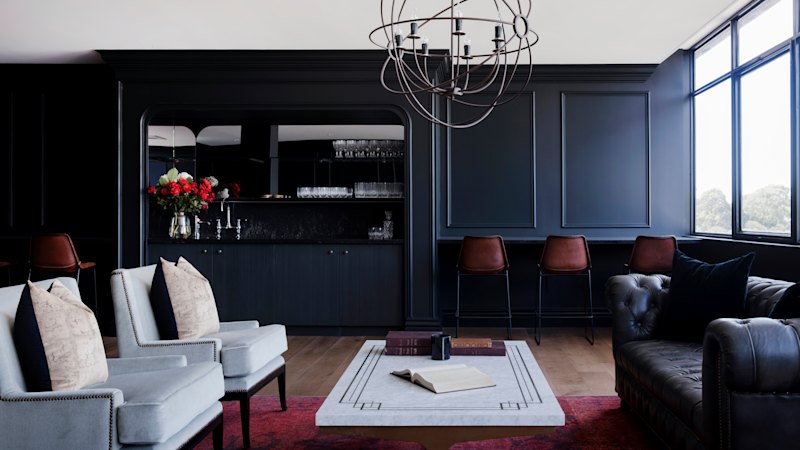
It’s no wonder then that so many of us seek to recreate that feeling at home. While it’s tempting to do a design “copy and paste”, mimicking the palette and materials from your favourite destinations, designers in the hotel and restaurant space say that is only part of the story. To really give yourself that moment to exhale when you walk in your own front door, focus on these aspects.
Clutter-free calm
One of the most notable experiences of hotels and restaurants is a lack of clutter. That’s not because there is a lack of “stuff”, but that there really is a place for everything. Design studio Tom Mark Henry has designed bars, restaurants and private residences in Sydney and Brisbane. Studio director Jade Nottage says storage is always a high priority.
“Everything is designed with a purpose,” she says. “With the waiter stations, you know exactly what is going in there down to the glass sizes and the cutlery – it all fits in like a beautiful little puzzle.
“We have some [residential] clients who think like that. They can tell us they have this number of bags and this number of shoes and a big platter that needs to be accommodated in the cupboard.
“Nothing is getting retro-fitted because it has all been thought through in the first place.”
Design intention
This rather nebulous term refers to the purpose of the space and takes in everything from functionality, like choosing the right tables and chairs for a restaurant, to how to get food to the diners in the most efficient – and safe – way possible.
Designer Silvana Azzi Heras has had an international career in hotel design – and stays in many luxury hotels. She says design intention is in the details.
“When you walk into a hotel room, you know you have arrived,” she says. “There’s a console to put your keys. Everything is considered.
“It’s the ease of movement – where you sit to read a book or go into the bathroom and there is a hook where it needs to be. They are small things, but it all adds up.”
Because they are accommodating large groups in small spaces, hotels and restaurants are also often studies in efficiency, says Studio Tate associate director Elizabeth Ride. The Melbourne-based firm has designed bars, restaurants and workplaces, as well as residences. Ride says some design elements work across all environments.
“There’s been a surge in popularity of built-in dining banquette seating in homes,” she says. “These often serve as a more casual alternative to a large, formal dining table and can inhabit interesting spaces such as window bays and kitchen island benches.”
Comfort
When creative director at Coco Republic Brett Kladney discusses comfort, he is not talking about bean bags. Coco Republic works across residential and commercial design, including Sydney’s Manly Pacific Hotel.
“[Comfort] doesn’t mean it has to be messy or unrefined,” he says. “It could be a lounge or an area where you are checking in, you can sit on a sofa, and you automatically understand that someone cares about you.”
Some signals of comfort are more subtle, but no less powerful.
“Whether you are going to a hotel or restaurant or your home, it’s like your haven,” Kladney says. “If you have painted your house in orange and red and have hard plastic chairs, that’s not comforting.
“If you go into a restaurant and the tables are all on one level, you may not feel comfortable enough to get up from the table and use the bathroom. But with different levels of tables, you will feel more comfortable to get up and down. That’s the subliminal ideas which happen in these restaurants.”
Lighting
If there’s one word to sum up hotel and restaurant lighting, it’s “layering”.
Founder and principal at Foolscap Studio, Adele Winteridge, says hotels and restaurants use lighting to create zones and set the mood, as well as provide safety.
Foolscap did the interior design for Barangaroo’s Noma, among other hospitality and residential projects.
“We have a strong ‘no downlight’ philosophy, favouring light and shadow from wall fittings, pendants, concealed joinery lighting, and localised task lights,” she says.
“This approach creates depth, softness, and intimacy – whether in a dining room, hotel lobby, or private living space – allowing the architecture and materiality to be revealed gradually rather than flattened by overhead glare.”
At home, turn the pendant light off and use table and floor lamps, preferably the dimmable variety.
Cordless rechargeable lamps, now common in restaurants and bars, are a great addition at home, although Nottage warns to check where the recharging dock is located.
“If you don’t have a power point nearby, a portable lamp is a great option to emulate that hotel lighting, but you have to be careful how they charge,” she says. “Sometimes they charge from the bottom, so while they are charging they are on their side.”
The unexpected
Unexpected moments of joy are built into hotel and restaurant design. While showstopping moments may be beyond the budget of most, designers say there are still ways to spark joy in unexpected spaces, taking cues from hotels and restaurants.
“You might have some beautiful cabinetry that from the outside is neutral, but you open it and there is a playful tile or stone embracing a sense of reveal,” says Nottage. “It’s a nice way to do it in your own home, and it’s enough to have those pockets of discovery.”
Small spaces like powder rooms can also be an opportunity to add richer materials such as stone, metallics or bold wallpapers.
Finally, don’t forget you’re the VIP at home. Make it work for you.
 Robyn Willis is a property reporter and the former lifestyle editor for The Sydney Morning Herald and The Age.