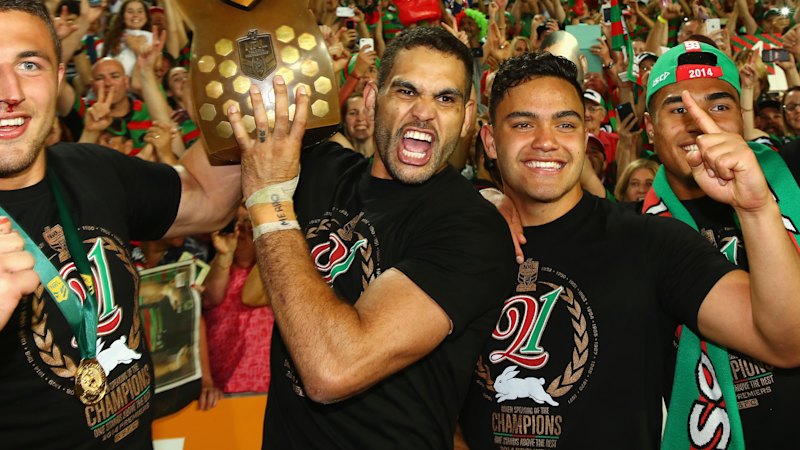

Greg Inglis still cuts as formidable a figure as he did during the height of his career.
But with one revelation, he exposes himself in the most vulnerable way, shedding light on the day he was almost lost forever.
“If I didn’t see my sister at that door, I wouldn’t be alive,” the Queensland Maroons legend tells this masthead. “It’s as simple as that.”
Alongside newly crowned IBF world welterweight champion Liam Paro, Inglis is fuelled by a purpose – to make sure others don’t suffer the way he has.
While the pair rose to fame because of their physicality, both have battled unseen demons.
For Inglis, it was his struggles comprehending retirement as he approached the end of a glittering rugby league career of 264 NRL games, 32 State of Origin caps and 39 Tests for Australia.
His former South Sydney coach, Wayne Bennett, warned him to have a plan for the transition he would face, having grown so accustomed to the regimented routine of life in professional sport.
“You do this 7am to 3pm, then you wake up and do it again. You do that three days straight, play on the weekends, and spend 10 months of the year together as a squad,” Inglis says.
“It doesn’t matter how long you want to play in the NRL, you still have to try to keep that normality of a routine.”
Inglis – who has spoken of his diagnosis with depression and bipolar II – descended into a spiral of alcohol abuse. During Magic Round in 2019, shortly after announcing his immediate retirement, he went missing for three days. There are parts of that period he cannot remember.
Eventually, he was found by his sister in Brisbane, before he checked into a rehabilitation facility for three weeks.
“I thought I was alone, I thought I couldn’t talk to anybody, and that’s the way I dealt with it. I dealt with it in a way no one should, in a bad way,” Inglis says.
“I just didn’t know the destruction I was doing on myself, and didn’t know the destruction I was doing around my loved ones. I had to change, or I wouldn’t be here.
“Six years later, I’m still trying to keep a normal routine.”
Paro’s experience with mental health struggles came through the suicide of his best mate Regan Grieve, a once-promising North Queensland Cowboys prospect.
The pair, who met playing under-8s rugby league in Mackay, had vowed to “conquer the world” – a phrase inked on Paro’s rib cage.
As he clinched his title by unanimous decision against Lewis Crocker at Brisbane’s Pat Rafter Arena on Wednesday night, Paro also wore Grieve’s initials printed on his shorts.
“I wish every day he was still here to be conquering the world with me,” he says.
“It’s not my journey, it’s our journey, and we’re still doing it.”
Suicide rates in their hometown of Mackay are high, at times have been up to 25 per cent higher than in the rest of Queensland.
But as inseparable as he and Grieve were, the rugby league talent kept his suffering secret.
Aged just 18, the now 30-year-old Paro was asked to carry his friend’s coffin, remembering it as “the worst day of my life”.
“I think about him every single day and what could have been,” Paro says.
“You learn to live with the pain, in a positive way, I guess I’ve learned to channel it into motivation, to propel myself and us.
“I’m never going to let the world forget his name.”
Inglis and Paro have joined forces, with the latter jumping on board as a supporter of Inglis’ Goanna Academy and Stick With It initiative.
The program has gone into more than 120 schools to encourage kids to speak about their mental health issues. Inglis also takes his work to Indigenous communities, and has begun conducting leadership camps.
The Rabbitohs and Storm great said he was convinced to take the academy further after speaking at one school, where teachers noticed a complete shift in one student – who sought the support of a counsellor after Inglis’ presentation.
Last year, 73 of the 781 suspected suicide deaths in Queensland were aged 18 to 24, with 373 occurring outside major cities.
Paro says intervention programs for teenagers are vital, and if they had existed when he was younger, he believes Grieve may still be alive.
“We used to tell each other everything, and there was obviously something he was battling that he didn’t even fill me in on. It just shows how dark, lonely and scary those places can get,” he says.
“It’s in that peak time in their life they’re transitioning into the real world – that’s when it’s hard. People feel lost … that’s the gap you need to fill.
“That’s where I lost Regan. Get them knowledgeable about it at a young age, so when they’re faced with that adversity and those demons, it’s not taking them by surprise.”
Inglis and Paro concede there is still a stigma in the hypermasculine environments of their sports that present barriers to men seeking support.
“It should be a normal conversation to have, and you shouldn’t be ashamed of it,” Inglis says.
“We come from such hard sports where your toughness comes through. But myself, Greg Inglis – the toughest of our sports – we’ve struggled with it too,” Paro adds.
“It shows that anyone from any walk of life, any pedigree with what they’re doing, can be dealing with something you’re so unaware of.”
If you or anyone you know needs help, call Lifeline on 13 11 14 (and see lifeline.org.au), national domestic, family and sexual violence counselling, information and support service 1800RESPECT (1800 737 732) or Kids Helpline on 1800 551 800.
Start the day with a summary of the day’s most important and interesting stories, analysis and insights. Sign up for our Morning Edition newsletter.