
There are about a dozen varieties of laksa from South-East Asia, but one style dominates menus locally. Why do we love deep-orange curry laksa, what styles are we missing out on, and where can you find a good one?
Annie Hariharan
If someone walks into Malaysian restaurant Kakilang’s city or Balwyn branch and asks for laksa, co-owner Ping Ch’ng assumes they mean curry laksa. Although there are about a dozen other laksa varieties from Malaysia, Singapore and Indonesia, curry laksa has become the go-to in Australia (or at least in Melbourne) when anyone mentions the noodle soup.
“Curry laksa was only meant to be on the menu for a limited time. However, it gained popularity very quickly and we decided to put it on permanent[ly],” Ch’ng says.
In Malaysia, the recipe for curry laksa is usually a spice blend which includes turmeric, lemongrass, garlic and ginger, simmered with prawn or chicken stock and finished with coconut milk. Yellow noodles, tofu puffs, prawns and strips of egg are then added to the rich ‘curry’ to make a satisfying meal.
But it’s just one of several soups that carry the name laksa. Apart from that label, all they have in common is a soup base with a spice blend, noodles and toppings that vary depending on the region and the dish’s evolution.
Hisham Abdullah, owner and chef of another Malaysian restaurant, Kantan in Fitzroy, thinks curry laksa’s dominance over its cousins is the broad appeal of its flavours.
Restaurant reviews, news and the hottest openings served to your inbox.
Sign up
“It uses ‘everyday’ spices like cumin and ginger so most people know the flavours.”
Trying to categorise or define South-East Asia’s various laksa dishes is like trying to pin jelly to the wall: entertaining but pointless. As Hisham cheerily says: “Laksa is like the English language: there’s rules but also lots of exceptions.”
There’s laksa made with coconut milk, ranging from deeply savoury versions with an orange-brown tinge (curry laksa, Sarawak laksa, Katong laksa, Bogor laksa) to milder tasting, herbaceous “white” laksa (laksam). In the fish-forward category, there’s a tangy version (asam laksa) and even a laksa which famously uses spaghetti for the noodles (laksa Johor) and is structured like a dry bolognese topped with fish gravy.
Out of all these styles, Kakilang serves curry laksa and asam laksa, the second-best known variety outside Malaysia.
Asam means sour in Malay, so the name gives away the taste profile. Kakilang’s version uses fish bones and mackerel for the stock, layered with belacan (fermented shrimp) and tamarind slices. The rest of the dish includes thick, chewy rice noodles and toppings that provide freshness, such as pineapple chunks, cucumber, mint and torch ginger flowers.
“The sour, fishy flavour can be an acquired taste,” says Ch’ng. “[But] if people have travelled to Malaysia, especially to Penang, they may order the asam laksa.”
As someone who grew up in the island state this pleases her, as it’s one of Penang’s famed dishes. But it’s certainly nowhere near as familiar as curry laksa among non-Malaysians.
Sarah Chan, executive chef of Melbourne CBD’s Waterside Hotel, has a different explanation for curry laksa’s dominance over other regional varieties.
“Curry laksa is mainly found in central [peninsular] Malaysia and Penang, which is much more well travelled and known to many,” she says. Not everyone – locals or visitors – ventures to regional states so they are unlikely to experience the sheer differences in laksa.
Chan is speaking from experience. Her hometown of Kuching, Sarawak is on a separate island almost 1000 kilometres from peninsular Malaysia. Its namesake laksa is her all-time favourite dish, a fixture of her childhood.
“It was the first bite of spice I had as a child of maybe six or seven years old,” she says. “Good laksa stalls have it from 7am to 11.30am and if you go after [that], it will be sold out.”
She’s put the dish on the menu at Waterside’s restaurant, Past/Port, which takes inspiration from all parts of South-East Asia and reflects some of Chan’s Nyonya heritage and upbringing.
The broth is made with chicken stock and infused with prawn shells, while a strong spice blend is aromatic with galangal and chilli. The laksa is then finished with coconut milk. Toppings of sliced chicken, egg strips and lime are Sarawak-inspired, but the two large grilled king prawns from Queensland are an Australian touch – and a way for Chan to showcase quality local ingredients. “It is a bit lighter than curry laksa because it uses vermicelli rather than the thicker, yellow noodles,” she explains.
Different styles of laksa
Coconut milk versions
- Sarawak laksa
- Katong laksa
- Bogor laksa
- Curry laksa
- Laksam (“white” laksa)
Fish-based versions
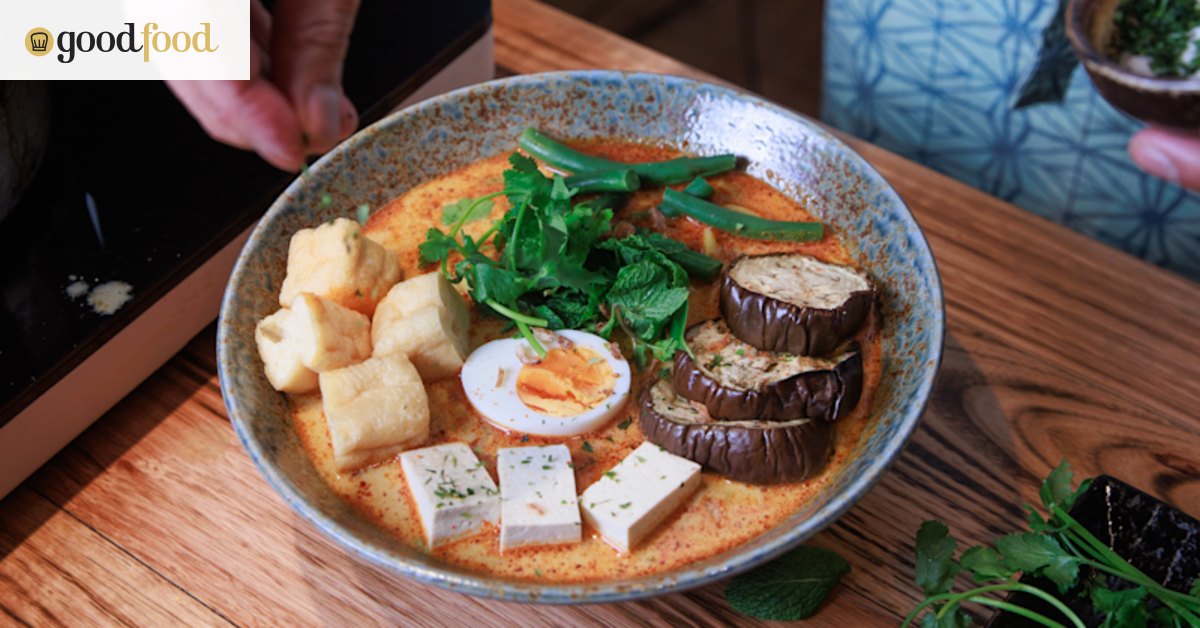
Although all laksa dishes have a strong meat or seafood component, Hisham has experimented enough to introduce a plant-based version of curry laksa.
“We started in Fitzroy and there were many people with vegan diets who kept asking us for options.”
Hisham’s curry laksa broth, which he developed over several months, uses granulated mushrooms and mushroom stock for savoury notes and a list of spices which includes fennel seeds and coriander roots. Tofu, green beans and roasted eggplant tie it all together.
Hisham reckons it has become far easier to make a vegetarian version of this Malaysian classic because there are now more vegan condiments and ingredients available. “There’s vegan fermented shrimp, which is a soy by-product, and vegan fish sauce.
“Our customers love that there’s a Malaysian restaurant that caters to both vegetarian and non-vegetarian [diners].”
Five places in Melbourne to try different laksas
For asam laksa: Kakilang
This casual eatery in the city and Melbourne’s east has curry laksa – a perennial favourite – but give the asam laksa a try. The soup is tangy and spicy, and comes with a generous portion of mackerel chunks plus cucumber strips for balance.
190 Bourke Street, Melbourne; 6/190 Belmore Road, Balwyn; kakilangckt.com
For curry laksa: Laksa King
One of the OG laksa eateries in Melbourne is best-known for its curry laksa. Whether it’s the fish head version with okra or the shredded roasted duck version, every bowl is hearty, flavoursome and generously proportioned.
6-12 Pin Oak Cres, Flemington; 3/39-51 Kingsway, Glen Waverley, laksaking.com.au
For vegan curry laksa: Kantan
At this cosy restaurant with trailing indoor plants, the curry laksa is plant-based yet deeply rich and flavourful from the spice blend. You can pick your own toppings to create a meat-centric, vegetarian or vegan soup, making Kantan a perfect spot for a group with varied dietary requirements.
152 Kerr Street, Fitzroy, kantan.com.au
For Sarawak laksa: Past/Port
The interior of this restaurant evokes a sense of dining in an ornate South-East Asian eatery: green-accented tiles, an intricate mural featuring koi fish for good luck, slow-rotating ceiling fans. Sarawak laksa is only available at lunch; staff will thoughtfully hand you a bib to protect your work clothes from soup splatters.
508 Flinders Street, watersidehotel.com.au/past-port
For vegan Sarawak laksa: Masak Masak
It’s South-East Asian hawker stall meets Melbourne cafe here. While the menu is seasonal, Sarawak laksa is a constant, available in both meat- and plant-based versions so it’s another great pick for groups with different diets.
128 Roberts Street, Yarraville, masakmasak.carrd.co