
Updated ,first published
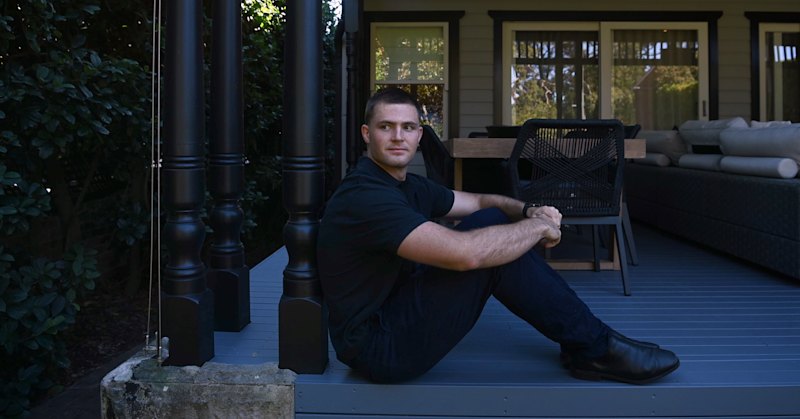
An innocuous decision by rising Waratahs star Henry O’Donnell to take medication to help him focus on his university studies has cost him 18 months of his rugby career.
Two days before facing the Queensland Reds in Sydney last May, O’Donnell sat down to complete a group university assignment for his business degree.
O’Donnell had always strongly suspected he had ADHD, but had never been diagnosed. To help him concentrate on academic work, he sometimes used his sibling’s medication. The NSW player understood he was fine to take the medication out of competition.
O’Donnell’s mistake was that the medication was still in his body when he played the Reds two days later on Friday, May 9.
“I’ve been tested multiple times. At the time of testing, I had no second thoughts about it, (but) three weeks later, I was notified that I had failed the doping control test.”
Despite the result, O’Donnell was still able to train and play rugby, including facing the British and Irish Lions last July, while pursuing a formal diagnosis for ADHD and a therapeutic use exemption.
A psychiatrist and psychologist subsequently concluded O’Donnell had suffered from ADHD since childhood. O’Donnell was granted the exemption by the Australian Sports Drug Medical Advisory Committee, but was told it wouldn’t apply retroactively to cover his positive test.
As a result, the Sports Integrity Australia banned O’Donnell for 18 months. After a lengthy SIA process, Rugby Australia and the NSW Waratahs issued a statement on Saturday announcing the sanction, saying he had tested positive to D-amphetamine and Ritalinic Acid, two prohibited substances associated with ADHD medication, without the exemption.
“I got a call at 5 pm (from Sports Integrity Australia), they said: ‘we’re letting Rugby Australia know in 15 minutes’. I said: ‘can you hold off?’ I need to call (Waratahs coach) Dan (McKellar) because I want to tell him’. I think Dan really appreciates that sort of upfront honesty and then I got stood down.”
There were numerous challenges for O’Donnell after that call. He was unable to visit the Waratahs to train or visit socially. The team environment had given him so much happiness since school, but he was forced to train alone in his garage.
The hardest part was not being able to tell anyone what had happened while the lengthy SIA process was under way. O’Donnell was open that he had made a mistake, but also knew he hadn’t cheated.
Most of his friends and teammates had no idea what had happened to him.
“I was starting to hear some pretty ordinary rumours. A few of my really close friends knew, but on the whole, my teammates knew absolutely nothing,” O’Donnell said.
“At the start, it was personal reasons, I then heard stuff to do with the police. I then heard doping. I heard everything.
“I was advised not to talk about it and I think out of the whole situation, that was probably the hardest thing.
“And my mates, to be honest, were not pushy at all. I didn’t get interrogated by any of the boys … but I didn’t want to kill my social life either, so to a few of my close friends, I said: ‘look, I’m not going to say what’s happened, but don’t ask me questions, but I’m still keen to hang out’.”
In March, O’Donnell got the formal charge letter from Rugby Australia and Sports Integrity Australia, formalising his 18-month ban. Rugby Australia and NSW Rugby said in a statement it noted “the SIA finding that the violation was not intentional and took place in a context unrelated to sport performance.”
“I think the most important thing for me coming out of that (letter) was, yes, I’ve made a mistake, and I’m copping a hefty punishment for it,” O’Donnell said.
“But more importantly to me, they acknowledged it was unintentional and taken in a context unrelated to sport, which vindicates me of cheating, which is something I’d never even think about doing.”
Some professional athletes hate the structured nature of their job. There is a detailed plan for every hour of the day, including what to eat, what to wear and what activity to do. O’Donnell loves it. From September, O’Donnell had to readjust to hours alone, carefully writing his workouts on the garage mirror.
“The first few weeks was probably a shock. I didn’t really know what to do with myself. I don’t think I’ve ever been too upset in front of the family,” O’Donnell said.
“I had to work out how to keep myself busy, I’ve worked so hard, I’m probably not the most talented, and I think a lot of coaches and players know I’m very competitive and I push pretty hard to get the most out of myself.
“It felt like I realised how good our job is every day. And I think that’s one of the things I’m taking out of this.
“I mean, I have so much perspective coming out of this on how good our job is every day, how much I actually do love the sport, love the boys, love the Waratahs, love the coaching staff.
“At the risk of using a cliche, but you don’t really know how much you sort of love it until it gets taken away from you.”
As part of his suspension, O’Donnell can’t play any sport in a competition, be it tennis or golf. He runs in a local park and continues to push himself hard in the garage.
O’Donnell is also working as a project manager under former Waratahs and Ireland international Matt Mostyn, before being able to return to pre-season training for the Waratahs in November. Most players dread this date; O’Donnell is counting down to it.
O’Donnell wants to share his story to ensure his teammates do not have to experience what he has.
“I understand the system pretty well now. Unfortunately, most athletes treat it like a box ticking exercise. It is so much more than that. Athletes need to understand the rules. They are what keep our sport fair and I’m all for that.
“I have no animosity. It would be easy to come out swinging, saying it’s all rubbish, what’s happened (to me), but I accept that (punishment), and I just don’t want anyone to go through what I’ve gone through.”
O’Donnell will be eligible to return to play for the Waratahs from January 1.
“Henry made an error of judgment and has paid a heavy price for that misstep,” Waratahs Director of High-Performance B-J Mather said.
“The club has supported Henry throughout the process and we look forward to his return.”