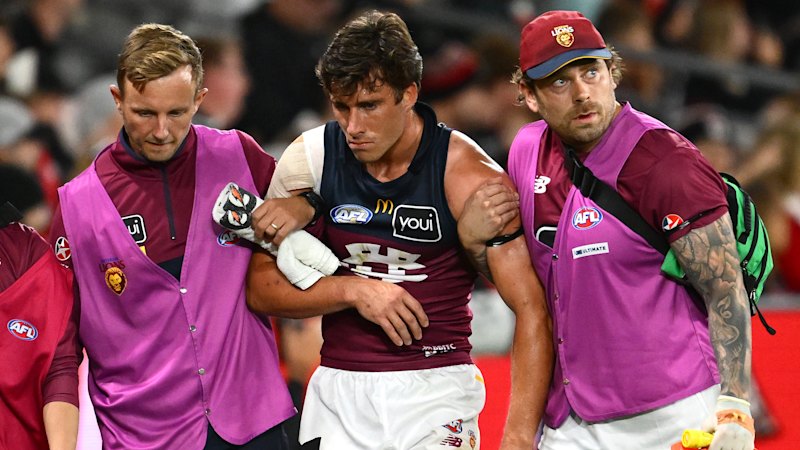

Breakthrough technology is poised to revolutionise the protection of grassroots athletes against concussion, as Brisbane Lions skipper Harris Andrews delivered an insight into teammate Noah Answerth’s head knocks.
Answerth suffered his second concussion of the season in his side’s two-point defeat to the Melbourne Demons in his comeback from his last incident, and will miss Sunday’s clash with the Adelaide Crows at the Gabba.
Andrews expressed concern for Answerth’s long-term health, having already watched former teammates Justin Clarke and Marcus Adams retire due to ongoing head trauma symptoms.
“There’s obviously concern there, he’s a good friend of mine, and you never like seeing guys get concussions. Obviously, a couple in a short period of time is concerning,” Andrews said.
“I think he’s feeling all right. He’s one of the all-time great teammates, he’s willing to do absolutely anything, and it’s sad to see him go down with a concussion, but we’ll wrap our arms around him.
“He plays the game in a way that’s probably not great for his body, but that’s part of the reason we love him so much, and why he is such a great teammate.”
While Andrews believed the Lions and AFL had worked diligently to better protect their athletes against concussion, of greater concern are the grassroots incidents that may get missed.
Concussions are behind more than half of all hospital admissions related to sport in children aged 10 to 15, with one in three parents barring their kids from contact sport for fear of head injuries.
Those findings have led to concussion management innovators HIT IQ devising the Proteqt mouthguard – used to detect symptoms of concussion as they occur – with the goal of rolling it out across Australia’s junior sports landscape.
Technology embedded in the mouthguard assesses brain signal changes upon impact and connects users to telehealth services to receive a diagnosis and determine a return-to-play timeline.
HIT IQ chief commercial officer Damien Hawes told this masthead 70 per cent of the 100,000 annual concussion cases in Australia go undiagnosed.
He said the likelihood of long-term health impacts from head trauma increase if successive concussions occur, while athletes have a greater risk of suffering other injuries, such as soft tissue concerns, if they return to play without sufficient recovery.
Hawes said returning to play before a concussion is properly cured also increased the risk of other injuries, due to poorer balance and cognitive speed.
“We know at the elite levels of the game, they have insulated mouthguard technology, video surveillance, spotters in the crowd, education programs, and doctors on site providing world-class concussion care and management. When you go to the grassroots, none of that exists,” Hawes said.
“At the grassroots, when the brain is developing, it’s when the brain is most vulnerable … that’s where you hear the horror stories.
“I deal with a lot of schools, and they have students who have missed years worth of education because by the time they go into the classroom and get a cognitive load, they become symptomatic and get headaches from learning.
“That tells me they’ve played through concussions, exacerbating those symptoms. Parents get scared, and we don’t want parents scared, we want parents to be empowered.”
The Rugby League Players Association has expressed fears that NRL rule changes, which have significantly increased the speed at which the game is played, are also putting players at greater risk of injury.
Efforts have increased for elite sporting bodies to better protect their athletes, with the NRL imposing a maximum of 100 minutes of contact training each week on a seven-day game turnaround.
“The players are the main product of the game, and you want to protect those assets as much as possible,” Broncos captain Adam Reynolds said. “I think it’s an initiative that every club will abide by.
“I know the risks that come with playing rugby league, I know what I signed up for, and I know there are accidents that are part of any sport. As players, we’ve got a duty of care to look after one another, and I feel it’s been good out there.
“No player goes out there to hurt anyone deliberately, unfortunately there are accidents.”
Start the day with a summary of the day’s most important and interesting stories, analysis and insights. Sign up for our Morning Edition newsletter.