There’s a project this season of Restoration Australia that’s unlike any seen on the series before. Its overhaul is not especially difficult. It doesn’t require hours of painstaking artisan craftsmanship to salvage its crumbling period features. Even host Anthony Burke admits it is a “fairly straightforward restoration project”.
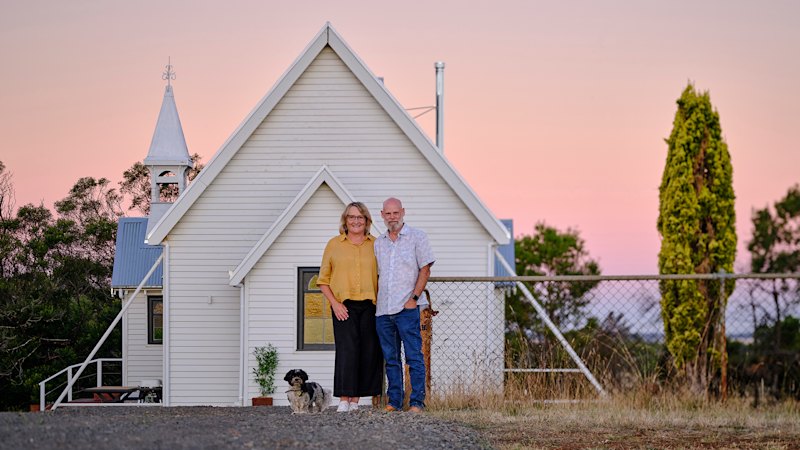
But the transformation of a small timber church in the south-west Victorian town of Breakaway Creek, population 50, is about much more than preserving bricks and mortar. Marking the first time a First Nations family has appeared on the program, this restoration is about reclaiming a place of trauma and dispossession, and honouring the lands of the Gunditjmara people.
“We really weren’t that interested in the church itself,” says Burke, a professor of architecture and host of Grand Designs Australia and its spin-off, Grand Designs Transformations. “We were interested in looking at a landscape … You can’t understand one without the other, and that’s not the same for a lot of the other places that we’ve followed.”
The vision of the church’s owner, Geelong cartographer Craig Molyneux, whose relatives lived at the old mission, was to turn it into a weekender. Along with structural repairs, and leadlighting depicting native birds to replace religious iconography, there was consultation with a native flora expert and a grass-weaving lesson from an elder, Aunty Eileen.
“Craig and [his wife] Ros were very conscious of the bleak history,” says Burke. “And yet, they still wanted to find a way forward and make a place for this conversation – as difficult as it is – to happen. I was floored by their generosity of spirit.”
Also featured this eighth season is the oldest property on the show to date: a decrepit 200-year-old farmhouse outside Moruya on the NSW south coast. There’s an abandoned convent in Boorowa, NSW, “the scale of which is something else”; an old pumping station outside Dungog in the Upper Hunter region; and a disused post office in Carlton River, Tasmania.
“Four of the six houses in the season actually didn’t start as a house,” says Burke. “A lot of people are thinking about adaptive reuse, so this was one moment when history gets contemporary … Because of the heritage component, you are asked to be forensic with the fabric of the building. You’ve got to be detailed as well as big picture.
“I think a lot of new builds just take it as a blank canvas. They bring in big ideas and get very generic, very quickly, but you can’t do that with an adaptive reuse. You’ve got to respond at every scale of the project and that requires a lot of attention and a lot of determination.”
Burke restored his own family home, a 1910 worker’s cottage, in the Sydney suburb of Annandale. “They’re not rational decisions that one makes in that first blush,” he says. “We choose these projects because we fall in love with a building, and then we rationalise what to do with it afterwards. But by then, it’s too late.”
The season opens with a Victorian-era monstrosity that couldn’t be further from the Breakaway Creek church, which is in episode four. In western Victoria, empty-nesters Jane Martin and Neil Gibbs take on the turreted bluestone mansion of nefarious squatter John “Scabby” Moffat.
“When you walk inside the front door and the hallway is big enough to put a cricket pitch in, you realise you’re in a different scale of ambition here,” says Burke. “The entryway archway was Arabesque. It was quite flamboyant.”
The property, of course, holds echoes of another chapter of colonial history.
“That area around Wickliffe doesn’t have a squeaky clean reputation for the way we’ve dealt with Indigenous Australians,” says Burke. “I think it would be a problem if we tried to hide the stories. What we need is a way to tell the stories that invites everybody to the table. They have to be there together so that we can try and make sense of our own history.”
Restoration Australia returns at 8pm on Thursday, May 21, on the ABC and ABC iview.
Want more TV? We’ve got you.
 Bridget McManus is a television writer and critic for Green Guide. She was deputy editor of Green Guide from 2006 to 2010 and now also writes features and interviews for Life & Style in The Saturday Age and M magazine in The Sunday Age.