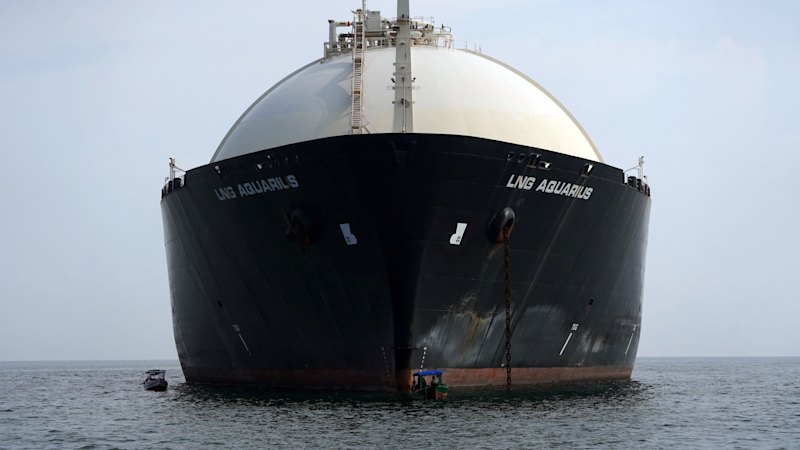

Labor is sending a delegation of top officials to Asia this week as it tries to head off a growing diplomatic crisis over its plans to force Australian gas exporters to hold back supplies for domestic use.
The diplomatic offensive includes senior bureaucrats from the energy, resources, foreign affairs and trade departments and responds to key regional partners’ concerns over the scope of the Albanese government’s looming gas-reservation scheme, set to take effect in July next year.
Energy companies and government officials in Malaysia, South Korea and Japan fear the scheme poses risks to their multibillion-dollar investments in the Australian gas sector and could threaten long-term national energy security – concerns conveyed via diplomatic channels to the Department of Foreign Affairs and Trade.
Australian bureaucrats will hold closed-door talks in cities including Tokyo and Seoul, according to correspondence seen by this masthead. They will also visit Singapore and Kuala Lumpur, industry sources confirmed.
At stake is Canberra’s relationship with the countries critical for the continued petrol and diesel shipments, which are in dangerously short supply due to the Iran war. Crucially, some of the biggest Asian buyers of Australian liquefied natural gas (LNG) are also the nation’s primary suppliers of transport fuel.
Under the government’s proposed gas-reservation scheme, from next year Australian LNG producers will have to set aside the equivalent of up to 20 per cent of annual export volumes for the domestic market. The policy attempts to fix a contentious economic disconnect: that the nation ranks as one of the world’s top shippers of LNG, generating $60 billion in export income last year alone, yet Victoria and NSW are at risk of shortfalls in coming years, further exposing households and factories to higher energy bills.
The move has won strong support from unions and the manufacturing sector, which hailed it as an essential intervention to mend a “broken” market following a threefold surge in domestic gas prices over the past decade. Without it, manufacturing bosses said, more Australian factories relying on gas to fire kilns and furnaces would have to close. “This is the most significant structural reform to Australia’s gas market in a generation,” said Ben Eade, chief executive of industry group Manufacturing Australia. “It is overwhelmingly in the national interest.”
Many crucial details of the policy remain unclear, and the friction threatens to fray decades of strategic trade ties at a sensitive time. Prime Minister Anthony Albanese recently used Australia’s reputation as a reliable supplier of LNG in bilateral negotiations with Malaysia, Korea, Japan and Singapore to negotiate priority access to their oil refineries’ dwindling output of fuel, as Iran’s closure of the Strait of Hormuz raises fears of a global crunch.
“We will exchange views on energy trade-related matters on a ‘no surprises’ basis, and deepen practical cooperation on energy security for both countries to achieve shared goals,” Albanese said in a joint statement with Malaysia’s prime minister in April.
Major Asian utilities such as Japanese giants INPEX and JERA, the Korea Gas Corporation (KOGAS) and Malaysia’s Petronas hold large stakes in joint-venture projects in Gladstone, Darwin and WA. The key motivation for their investments was the establishment of long-term LNG purchase deals guaranteeing supply of gas they need to power their countries’ electric grids, heaters and manufacturing plants.
However, these companies have become unsettled by a lack of clarity from Australia on the workings of the reservation scheme. The government has pledged that long-term LNG contracts signed before December 22 would be respected, maintaining that further consultations are needed to finalise the scheme, but a series of government briefings over the past two weeks added to Asian buyers’ unease.
“Concerns have only heightened following industry engagements on the draft framework,” a senior industry source said.
A cause of concern is the significant degree of ministerial discretion in the draft scheme to alter reservation volumes or grant carve-outs, which could change from one year to the next.
Other industry players query the specific implications for the Santos-led Gladstone LNG project (GLNG) in Queensland, whose backers include KOGAS and Petronas. Queensland’s other two LNG plants, run by Origin Energy and Shell, send gas to the domestic market and overseas – but GLNG is fully contracted with no spare gas to set aside.
Under the draft rules, it would be required to prove it has exhausted all viable options to source additional supplies – such as buying the extra gas from third parties or lowering exports – before it could secure an exemption. Companies that failed to comply with the policy could face penalties of up to $100 million.
Resources Minister Madeleine King said the reservation would ensure fair prices for local gas users while maintaining Australia’s status as a reliable regional partner.
“We are designing this scheme in a calm, methodical and consultative way. We have been clear that we will respect existing contracts,” King said.
Samantha McCulloch, chief executive of industry body Australian Energy Producers, said uncertainty about reservation rules threatened Australia’s reputation for reliability.
“The prime minister has recognised that Australia’s liquid fuel security is tied to our LNG exports,” she said. “In the middle of a global energy crisis, the last thing Australia should be doing is putting the trade relationships that underpin our fuel and economic security at risk through a poorly designed gas reservation scheme.”
Meanwhile, smaller Australian gas producers, which do not export, acknowledged that a “modest” market oversupply would reduce prices, but warned of the risk that many new projects may not be viable if the cuts were too deep. Oil and gas producer Beach Energy cited analysis by advisory firm Kroll to argue that the reservation scheme, if not carefully designed, would “act as a handbrake” on local gas exploration, development and production. “As currently drafted, the scheme undermines the objectives it is meant to serve,” chief executive Brett Woods said.
Cut through the noise of federal politics with news, views and expert analysis. Subscribers can sign up to our weekly Inside Politics newsletter.
 Nick Toscano is a business reporter for The Age and Sydney Morning Herald.Connect via X or email.
 Mike Foley is the climate and energy correspondent for The Age and The Sydney Morning Herald.Connect via email.