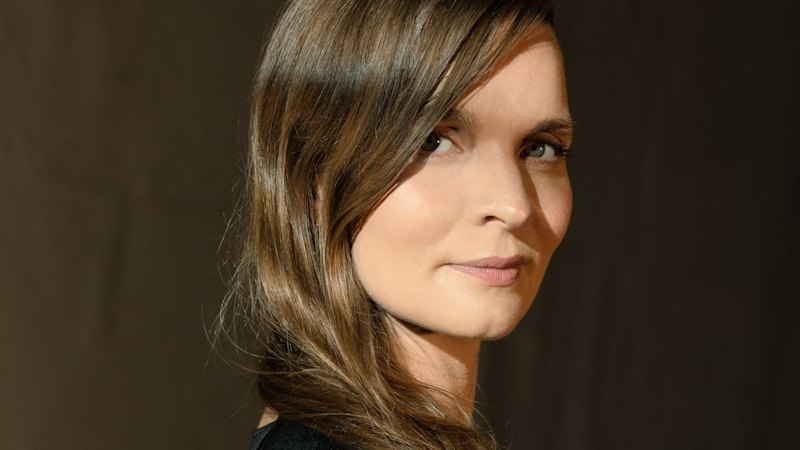
When Hildur Gudnadottir’s new classical work, commissioned by the Australian Chamber Orchestra, has its world premiere in Australia this month, the Oscar-winning composer’s hectic schedule won’t allow her to attend.
“Sadly, I won’t be there for these performances because I’m working with some other Australians this summer in Europe,” the Icelandic composer and cellist says apologetically from her home in Berlin. “I’ll be connecting with your fellow country-folk in London.”
As far as excuses go, it’s a good one. Those Australians are Helpmann-winning theatre director Benedict Andrews and Cate Blanchett, Gudnadottir’s castmate on the 2022 film Tar. The trio, along with another Tar star, German actress Nina Hoss, are starting rehearsals on a new National Theatre production titled Electra/Persona, a play that blends Sophocles’ ancient tragedy with Ingmar Bergman’s 1966 psychodrama.
If that wasn’t enough, the 43-year-old’s also starting work on the score for another high-profile gig that month when shooting commences on director Sarah Polley’s adaptation of Sylvia Plath’s The Bell Jar, starring Billie Eilish. “It’s a very busy time,” Gudnadottir says, an understatement if I’ve ever heard one.
Given such commitments, how’s the deadline coming on that ACO piece? Gudnadottir laughs. “I’m still working on it, but I’m nearly done. The gist of the piece I wrote a few weeks ago, so I’m quite relaxed about it,” she says.
In a program designed to evoke “the snow-strewn mountains and shores along the Baltic and Nordic seas”, From Winter’s Stillness will see Richard Tognetti and the ACO performing Gudnadottir’s piece alongside the Norwegian/Swedish vocal group Trio Mediæval and Norwegian jazz trumpeter Arve Henriksen.
“They asked me to write a piece and I couldn’t say no because I think they’re just magnificent,” says Gudnadottir. She is longtime friend of Henriksen – the pair also worked together on the score for Nia DaCosta’s 2025 film, Hedda. “I think he’s one of the greatest trumpet players of our time, really.”
Given the prompt that “water” would be the concert’s unifying theme, Gudnadottir had an immediate idea she wanted to explore as “the Icelandic representative” among the program’s Nordic focus. It was the 1948 avant-garde poem Time and Water by Icelandic poet Steinn Steinarr, a poem her grandmothers used to recite to her as a child and one she’d long wanted to write music to.
“Water is a huge part of the Nordics because we’re surrounded by it and it is the thing that both divides us and unites us,” says Gudnadottir. “Steinarr was, I guess you would say, a socialist in those post-war times. He had such beautiful ideas about people’s rights and our shared humanity.”
For someone best known for her work in film and TV, it’s interesting that the impetus for her orchestral piece returned to storytelling. “Music, for me, is just communication, a way that we express feelings and thoughts and ideas without words. With this piece, you could listen to it knowing that I’m thinking about water and that’s enough. Or you don’t even need to know that.”
‘The question of whether something is sound design or music, I get that a lot less now.’
The last time I interviewed Gudnadottir was in 2019. Her haunting score for the TV series Chernobyl had just marked her breakthrough, and she was about to commence work on her first lead film score for Joker.
In the interview, she candidly discussed Hollywood resistance to the kind of scores she – and her late mentor Johan Johansson – had pursued, where they integrated field recordings and sound design alongside traditional orchestration. In the years since, Gudnadottir won an Oscar for Joker and has become one of Hollywood’s most acclaimed and in-demand composers. Does she feel her ideas are more accepted now by the industry or is she still fighting the battles of yore?
“I think they are much more accepted. The question of whether something is sound design or music, I get that a lot less now,” laughs Gudnaddotir. “I think people have become more excited about different ways of working on scores. Excited but also a bit scared at the moment because of all this talk of AI in screen music. But for myself, I definitely feel I have to fight much less for my ways of thinking to be accepted.”
Winning an Oscar will do that for you, I guess? “It does, definitely,” she says. “I feel like nine years ago when I was suggesting these ways of working to productions, they were maybe nervous that I wouldn’t be able to see them through because people didn’t know who I was and whether I’d be able to handle it. That’s understandable! These film productions are big and bulky things, and there’s a lot of pressure because people invest a lot of time and money and people power so they want to be able to make sure things simply get finished.
”The composer comes at the end of that process – music is the thing that can change the most at the latest point – so there tends to be quite a lot of pressure on the composer towards the end of a project, which means people need to be able to trust that the person that takes on that job has broad shoulders and is able to navigate that kind of pressure. I think that’s why people were scared of changing the ways they were used to working.
“So when you win things and you have awards and stuff to show that this process is actually viable, that definitely gives people peace of mind. It’s like, look, this golden man is telling you to trust me!”

In our last conversation, Gudnadottir highlighted Antonio Sanchez’s score for Birdman – an extended drum solo that eschewed melody for tension – as a bold piece that tried something different in Hollywood. Is there a recent score that stands out for her? “I think what Ludwig [Goransson] did in Sinners was wonderful,” she says. “It was such a great film and the music was so fun and exciting. I remember coming out of the cinema like, ‘Yes!’”
The success of that score was testament to the close relationship between Goransson and director Ryan Coogler, says Gudnadottir. “That’s one of the things I’m interested in, how you can develop a friendship and a creative collaboration with someone where it’s not just about the work you create, but it’s about the connection you have. You can go so much deeper with people you trust and love and communicate with in an honest and joyful way.”
Gudnadottir has cultivated her own such relationships, working primarily with female filmmakers such as Sarah Polley, Nia DaCosta and Maggie Gyllenhaal. “I don’t pick my projects on whether people are male or female, but the connection is important, and I’ve been lucky to have people like Sarah and Nia where we’re interested in the same ideas and it makes for a great working situation. It just so happens that they’re women, and I think it is amazing to see how many more women directors we are getting chances to work with today,” she says.
She recalls the “incredible speech” Blanchett delivered as Cannes jury president in 2018 when she was joined on the red carpet by 82 women, including filmmakers Agnes Varda and Ava DuVernay – the number of female directors who’d had films in competition throughout Cannes’ history up to that point, compared to the 1688 men. “When you see those statistics and the space women have in modern storytelling, it is baffling because women make up 50 per cent of people,” says Gudnaddotir. “We’re still hearing just a fraction of the stories women have to tell.”
It’s a discussion that arose following Gudnadottir’s Oscars triumph in 2020, too: at the time she was the first female composer in over 20 years to win an Academy Award and, in the near-decade since, there hasn’t been another. “It’s changing but very slowly. Very, very slowly,” says Gudnadottir of the barriers for young female composers in Hollywood.
“I was hoping things would change faster. But we need to keep chipping away and keep opening doors and hopefully we’ll see more, because we still have so much to hear and learn and experience from the female point of view.”
From Winter’s Stillness, featuring the world premiere of Hildur Gudnadottir’s new work, is at Melbourne’s Hamer Hall Arts Centre on July 26-27; at Sydney’s City Recital Hall on August 1,4,5 and 7; and at the Sydney Opera House on August 9.