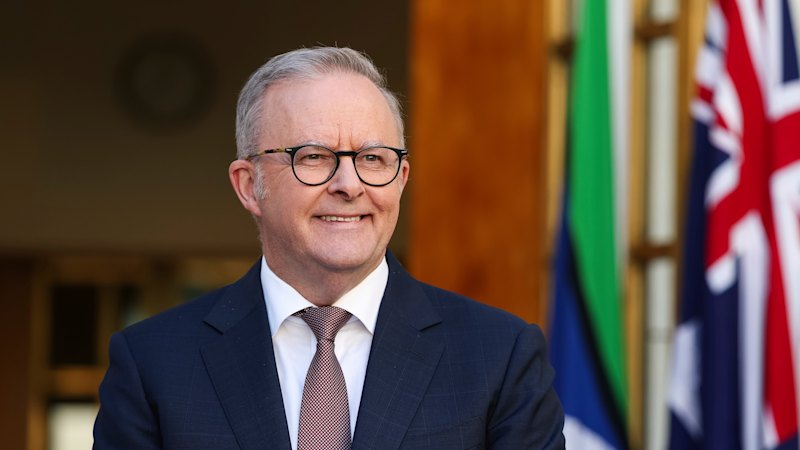

One year into a difficult second term, Anthony Albanese says absorbing the nation’s anger and grief is part of the job of being prime minister, while declaring he will absolutely seek a third term and at least nine years in office.
Before the anniversary of his second election win on Sunday, this masthead interviewed the prime minister by phone on Wednesday, before the Royal Commission on Antisemitism and Social Cohesion’s interim report was released.
Asked if he would seek to lead Labor to the next election, due in 2028 – by which time he would have served longer in the top job than every Labor prime minister except Bob Hawke – Albanese does not hesitate.
“Yeah, absolutely. I’ve been enjoying the job. I’m honoured to do it. I’m energised by it. I don’t think anyone sees any slowing down, and I’m optimistic about the opportunities which are there,” he said.
Though both his political allies and enemies have long suspected Albanese would seek a third term after he won a record 94 seats in 2025, the confirmation that he will run again is significant for the signal it sends to a handful of ambitious ministers to cool their heels.
The prime minister was widely criticised for his initial response to the terrorist attack at Bondi Beach on December 14, in which 15 people were massacred at a Jewish Chanukah festival.
He was the focus of anger from the Jewish community, long simmering over Labor’s response to antisemitic attacks, and his weeks-long reluctance to sign up to a royal commission was tracked by drops in the polls and even booing at commemorations.
But the prime minister stoutly defends his actions over the summer.
“Within 24 hours, some sought to politicise what was an atrocity and a terrorist attack and it’s up to them to justify that. My focus was on working with security agencies on keeping people safe and, you know, we didn’t know at that point in time whether it was the first of a series of attacks,” he said.
“I convened the National Security Committee at 9.30pm that night. I met with New South Wales Police and did a press conference early the next morning, met with Bondi police in the Bondi police station and visited the site before 9am on the Monday [the next day], having flown in after midnight into Sydney.”
Albanese downplayed the personal impact of the searing criticism he faced.
“In public life, you’re going to be a shock absorber for criticism, and that is part of the responsibility that comes with the privilege of holding the position,” he says.
Now Albanese is steering Australia through another difficult crisis – with no end in sight.
The US and Israel’s war with Iran has throttled fuel supplies in the Strait of Hormuz, sparking panic buying at fuel pumps, feeding into already-rising inflation and sending the prime minister door to door in Asia seeking to shore up supplies of diesel and petrol.
He acknowledged that “we don’t know how long” high global oil prices and the war could last.
“This will have an impact on global energy supplies [for some time to come]. We don’t know what the damage is in the Strait of Hormuz. We have to deal with these challenges. One of the things that it does do is just reinforce my government’s focus on resilience and being less vulnerable to these global shocks,” he said.
And while the prime minister stopped short of confirming changes to capital gains and negative gearing tax breaks in the May budget, he conceded that his views on tackling the tax breaks have shifted since he took over as opposition leader in 2019 and junked the policies Bill Shorten took to two elections.
“We’ve put a range of measures in place. Housing supply is key, we absolutely think that is the case. But the issue of intergenerational equity is one that is increasingly of concern, and it’s legitimate for young people to say, ‘well, how can I get a crack at the housing market?’ So that’s the context of the political debate that’s taking place,” he said.
“I’m not talking about those specifics [CGT and negative gearing] obviously, people will have to wait for the budget. But Labor governments always do the big things. We do the big reforms, and we don’t shy away from that.”
After four years in office, Albanese points to a list of achievements – income tax cuts, expanding paid parental leave, securing pay rises for workers on the minimum wage and cutting student debt.
He’s worked hard to manage complex relationships with superpowers, notably Chinese President Xi Jinping and US President Donald Trump, the latter having alternately praised and lashed out at Australia.
Albanese is aware he will soon have served longer in office than Labor greats Paul Keating and Ben Chifley, whose terms fell short of five years.
But he ducks questions about whether he could serve longer than the legendary Bob Hawke, who served just short of nine years and won four elections.
“I’m not getting ahead of myself, and I take nothing for granted. Winning elections is always hard, but I tell you what I’m focused on is where we are at the moment, the immediate challenges, dealing with them, but I’m also focused on where we’ll be at the time of the next election and the longer-term challenges,” he said.
And he is scathing of the Liberal opposition, led by Angus Taylor, suggesting that they are increasingly not acting like an alternative government and accusing the Coalition of acting “irresponsibly during the current crisis”.
“They are defined by what they’re against rather than what they’re for, and they are allowing people from outside to set their agenda,” he said, referring to the rise of One Nation and the Coalition’s shift to the right on certain issues.
But Labor, the prime minister said, will take the fight to One Nation “by having real policies that make a real difference for working people”.
“One Nation continue to vote against workers’ interests. They voted against same job, same pay. They don’t support tax cuts for working people,” he said.
“They’re filling a gap because the Coalition have stopped trying to act like an alternative government.”
Cut through the noise of federal politics with news, views and expert analysis. Subscribers can sign up to our weekly Inside Politics newsletter.
 James Massola is chief political commentator. He was previously national affairs editor and South-East Asia correspondent. He has won Quill and Kennedy awards and been a Walkley finalist. Connect securely on Signal @jamesmassola.01Connect via X or email.