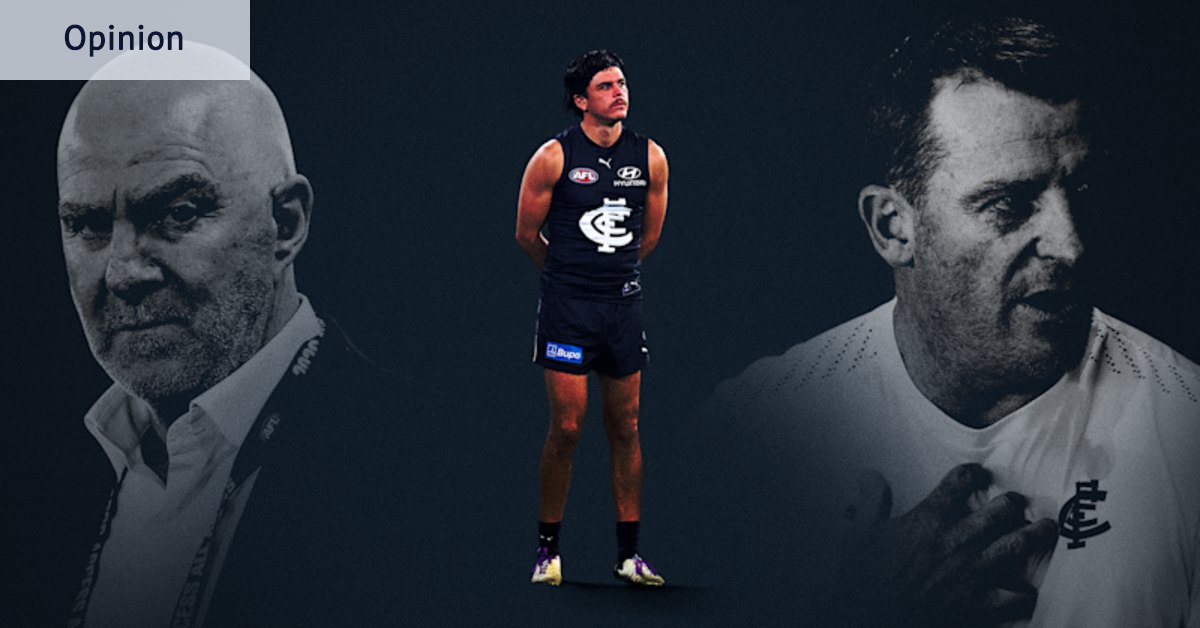

There was some cautious optimism about the new-look Carlton Football Club one year after the previous president resigned due to a lewd photograph scandal.
Few expected senior coach Michael Voss to remain beyond this season, nor the club to play finals after three senior playing stalwarts had walked out. However, the Blues had a new chief executive, a new football boss and a transformed line-up of new assistants around the senior coach.
But losing, as they say, exposes cracks in football clubs that winning papers over. First it emerged that new chief executive Graham Wright had last year – directly or indirectly – approached Collingwood coach Craig McRae about crossing to the Blues. Then former captain Sam Docherty’s brutal assessment of the team’s repeated on-field failings was made public.
All senior coaches have mentors, but an awkward situation arose because Voss has a paid adviser, Adam Simpson, who also works as a media commentator. Simpson was forced to repeatedly assess the Blues’ late-game capitulations, week after week.
None of the above will have any bearing when Laura Kane, the AFL’s football operations and medical boss, assesses Carlton’s explanation of what took place at the MCG on April 16. Elijah Hollands, the troubled footballer delisted by a disappointed Voss last year and then picked up again after working his way back to good health and fitness, was selected to play and remained on the field for more than 60 per cent of the clash against Collingwood.
The brutal truth is that the club’s handling of Hollands, hospitalised in the days following that now infamous night, exposes the Carlton Football Club and its administration as a group in disarray. Whatever other struggles the Blues are enduring behind the scenes, and for all the lack of leadership and system exposed in the manner of their losses, the failure to adequately deal with Hollands that night exposed a failure at the coalface of the club.
The club’s handling of the fallout that followed has also fallen well short of expectations from head office, Carlton’s members and supporters, and the wider football and sporting community.
No one is blaming Travis Boak for the mishandling of Hollands, but it’s worth pointing out that the Blues added another layer into their football operation this season, with the addition of the ex-Port Adelaide captain in a leadership and culture role, and we are yet to witness the results. The internal communication failure in round six is mirrored by Carlton’s ordinary external messaging.
Pleading for Hollands’ privacy since the club’s mishandling exposed the player and his issues (which the media has respected), Carlton have taken a week to hand a dismayed head office their written explanation for what took place.
Even accounting for how upset certain club bosses, medical staff, players and coaches must feel about what took place and how difficult it must have been to face the public, Carlton have not presented adequately.
No one has expressed remorse for what took place and, in fact, the club chose to point the finger at the media and the coverage of a series of circumstances that unfolded in prime time and has never been witnessed in my memory.
You cannot help but feel that Voss will be at least one person to take the blame for allowing Hollands to keep playing. After all he is the head coach, who knew the player was struggling and spoke to him at half-time, and Hollands communicated that he wanted to keep playing.
And Voss had to front the media on Thursday as is normal in the weekly footy news cycle. Perhaps football boss Chris Davies or Wright (the latter having held a press conference last Sunday) would have been more appropriate given the circumstances, although clearly that will come once the AFL forms its own view of Carlton’s work practices.
Voss came prepared, with notes. He strongly defended his staff, as was his right, and refused to explain what happened during the game. He threatened to end the press conference if questioning on the handling of Hollands continued, concluding by again turning the spotlight on the media. Voss said everyone surely has experienced a mental health problem themselves or within their circle, and urged the media to think about that.
“Unfortunately, rather than make this a private challenge, we’ve made this a public event,” said the coach. “So the commentary, the ball-by-ball play, we’ve unfortunately made it that.”
Voss badly missed the mark here. As my colleague Sam McClure pointed out, Voss and his team created this very public event by continuing to play Hollands well into the second half in front of nearly 80,000 people at the MCG, on prime-time national television, despite the red flags.
Carlton have continued to miss the mark since that night.
Immediately after the game, when the coach failed to address what had happened, the suggestion was that Hollands was remorseful. Voss said Hollands felt he had let the coach down, and this narrative continued as the week unfolded. That Hollands felt dreadful about the pressure he had placed on everyone at Carlton.
When Wright, an experienced football boss but clearly inexperienced chief executive, fronted the media last Sunday, two full days had passed with no explanation and only a brief press release; clearly, Wright or his football lieutenant Davies had to finally step forward.
But he offered nothing by way of explanation. He admitted the club knew Hollands was struggling during the game but could not say why no one had forcefully intervened. Despite multiple sources from Collingwood saying Hollands had told them he had been drinking, Wright said he had had no suggestion of that “at this stage”.
Voss said on Thursday the commentary in the aftermath of the Collingwood game had bordered on “bullying” and went on to defend his staff who had been the victims of said bullying. He said the families of these Carlton people – presumably football officials, coaches and medical staff – had been impacted.
The AFL’s assessment of Carlton’s medical team looms as particularly compelling given the increasing pressure on club doctors regarding concussion, the ARC operation, their crucial role in the illicit drugs code and the rising risk of general medical liabilities. The game is moving beyond the volunteer framework that served it for decades.
That includes club doctors who, in many cases, are starting to question the worth of combining their increasingly scrutinised match-day roles with separate medical practices.
Even accepting that Carlton staff, including Voss, have gone above and beyond in helping Hollands and showing him care and empathy, the bullying accusation was frankly unacceptable given the circumstances. This was not the day to point the finger.
The AFL is the biggest sporting competition in the country. It might demand compassion, but it also demands ruthlessness, a winning culture and external and internal scrutiny like few other fields. Voss should know that; it’s the way he led the gladiatorial Brisbane Lions during their glory years.
Whether the AFL investigation into Carlton, which continues next week, punishes the club, uses its failure to further reform match-day practices or both, the inescapable conclusion is that the Blues – for all their good intentions – failed their player against Collingwood at the MCG.
Their practices, which put the entire competition under scrutiny, did not meet the level of professionalism the game demands.
Keep up to date with the best AFL coverage in the country. Sign up for the Real Footy newsletter.
 Caroline Wilson is a Walkley award-winning columnist and former chief football writer for The Age.Connect via email.