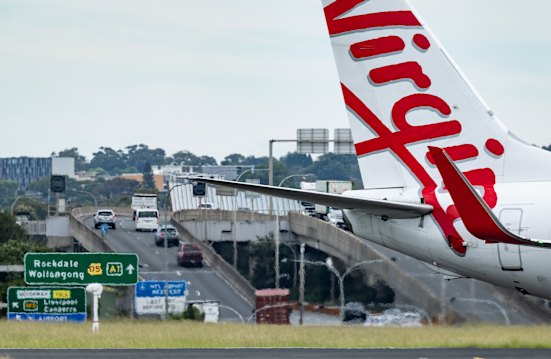
Virgin Australia has laid off a number of employees in corporate roles, the latest sign of contraction in the aviation industry as it grapples with higher costs triggered by the Middle East war.
The airline refused to say how many jobs have been eliminated but described the reduction as an “adjustment” that it makes “from time to time.”
“Like all businesses, we continually review our operating model to ensure we remain a strong, resilient business for the long term,” a spokesperson for the airline said.
“As part of that focus, we have recently made some adjustments affecting a small number of corporate roles, as we do from time to time.”
Airlines have come under cost pressure since the war with Iran erupted in February, wreaking chaos in global aviation, driving up oil prices, and, by extension, jet fuel prices.
Virgin has been forced to make cuts in flight schedules and push through increases to ticket prices to help protect its profit margin.
The company’s extensive fuel hedging strategy has limited the cost increase linked to fuel to $30 million to $40 million in the second half of 2026.
The cuts by Virgin of non-customer-facing staff follow a similar move by Qantas, which announced 400 job cuts at corporate headquarters in December. The job cuts were leaked to corporate gossip website The Aussie Corporate.
The aviation sector is facing the twin pressure of higher structural cost, driven by the oil crunch in the Middle East, as well as the drive to gain efficiencies from the deployment of new technology.
This trend has also seen banking jobs eliminated at the Commonwealth Bank, National Australia Bank, and Bendigo and Adelaide Bank recently, while ANZ Bank announced sweeping job cuts last year.
Still, underlying demand for air travel remains strong.
Virgin’s pre-tax earnings, posted before the Middle East crisis, rose 11.7 per cent to $490 million in the six months to the end of December. At the time, Virgin was helped by strong revenue growth and leisure demand.
But conditions have shifted for the global industry with fuel cost and fuel scarcity eating into the profits and the number of routes flown by airlines.
Data from aviation analytics company Cirium shows that global capacity for May reduced by about 3 percentage points. The Albanese government said on Tuesday that it secured three shipments of jet fuel from China. Qantas, which could face additional fuel costs of up to $800 million in the second half of 2026, said it welcomed the development.
On Friday, low-cost carrier AirAsia said it was scuppering its daily Melbourne-Bali flights less than three months after they had launched because the routes were no longer viable.
The decision had been made “in response to the sustained increase in global jet fuel prices caused by the ongoing geopolitical uncertainty in the Middle East,” said AirAsia Indonesia’s general manager, Achmad Sadikin Abdurachman.
The Market Recap newsletter is a wrap of the day’s trading. Get it each weekday afternoon.
 Chris Zappone is a senior reporter covering aviation and business. He is former digital foreign editor.Connect via X, Facebook or email.