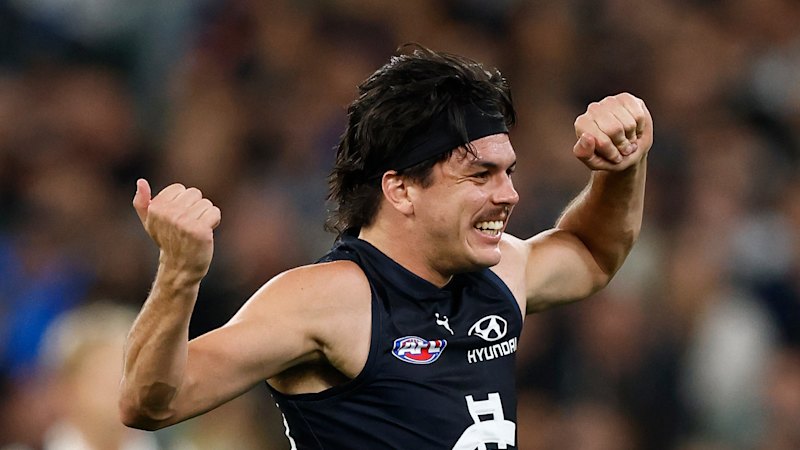

When a player is hit on the head on the football field, an established protocol is quickly invoked and treatment escalates to the point where a suffering player is quickly removed from the game.
There appears not to be any such protocol for dealing with a player who has a known history of mental health issues and is suffering a possible mental health episode. One of the many questions Carlton and the AFL must ask now is why not?
The rarity of it – described by Carlton CEO Graham Wright on Sunday as “unprecedented and complex” – is the obvious explanation. But fires are rare too, yet you still have a drill.
Elijah Hollands told friends, family and teammates after Thursday night’s game he was embarrassed by what happened and felt he let people down. Assuming the available facts are all correct – they are being reviewed and investigated – then Hollands had a mental health episode. That is not his fault.
If he had been drinking, as has been suggested? Well, that changes things. If as reported, Collingwood players picked up on it, why couldn’t Carlton coaches or medical people?
Wright said on Sunday that, at this stage, they still do not believe Hollands was on drugs or alcohol on Thursday night. This is presumably based on Hollands being adamant in the rooms after the game that he had taken nothing, and doctors agreeing. There had been no time for drug test results, and besides, unless Hollands approved the release of those results, neither the club nor the AFL could make them public.
When Carlton chose to keep Hollands on their list this year, they did so in the knowledge of the issues he has been facing. They are issues he discussed candidly in an interview with this masthead’s Peter Ryan at the start of the year.
Wright admitted the club knew during the game something was up with Hollands. On the one hand, it is alarming that they knew something was awry and no one intervened.
But secondly, it would be worse if they had no idea something was up during the game given the amount of footage of Hollands’ strange behaviour.
So the questions now are, if people knew he was not right, what happened next? Who took control? Did anyone? Who made the decision to keep him out there?
Wright could not answer – and indeed said he was asking the same questions of his staff – as to why nothing was done to pull Hollands from the game.
No doctor will knowingly ignore someone they think is having an anxiety attack, panic attack, or other mental health episode. So it can only be assumed Hollands was lucid in communicating with doctors and able to pacify them that he was OK, even if footage of his behaviour was confronting.
A slight complication for the doctors, medical staff and coaches is that Hollands is ordinarily known to be a nervy, fidgety type on game day, so distinguishing between regular nerves and something more extreme might not be quickly apparent.
Coaches, physios and doctors immediately detect a player with a limp or a change in running gait and get them off the ground for treatment. Yet no one thought Hollands carrying on as he did was so untoward as to think they should get him off the ground for his own sake.
You might have thought at the very least a coach would ask what the hell was going on with the player who had not touched the ball all game?
The blueprint to beat Hawks
Port Adelaide didn’t beat Hawthorn, they were not good enough for that. But that they got so close and confounded Hawthorn so completely for large stages will provide others in the competition a plan for how to beat them.
Their blueprint for beating Hawthorn looked to be written by a Hawthorn premiership player and coach.
Andy Collins was Hawthorn’s head of development for three years. He’s coached everywhere since he stopped playing. From his premierships as a player, to assistant coaching at AFL level, to coaching state league teams, he has tasted success nearly everywhere. In the off-season he moved to become Port Adelaide’s new director of coaching.
If Port’s game plan for taking on Hawthorn was dusted for coaching fingerprints, Collins’ would have been all over them.
That is not to diminish fledgling coach Josh Carr, but the game plan for Hawthorn was a departure from Port’s early-season method of play. It looked tailored for this one particular opponent that Collins had deep and recent knowledge of.
The plan in essence was simple: don’t feed Hawthorn’s tall intercept defenders Tom Barrass, James Sicily and Josh Battle. So don’t go forward long to contests when avoidable. Hold. Switch play across the wings and half-back. Own the ball with uncontested passing and frustrate Hawthorn through the midfield. The forwards had to spread the defenders by leading into pockets, with Jason Horne-Francis, who was excellent on the day, a regular target.
Hawthorn, like most teams, prefer a zone defence that allows them to saturate contests with numbers. The further idea seemed to be that, while Barrass is elite in the air, he can be cumbersome and exploited once the ball is on the ground. It took until the end of the third quarter for Barrass to take his first intercept mark.
The plan didn’t always work, Port departed from their method at times or were brought undone by their own skill level. But the plan itself was smart.
After Hawthorn started the game like it would be a romp, Port changed up their commitment to the plan in the second quarter, kicking six unanswered goals. They owned possession of the ball and territory on the ground, with the ball bouncing out of the Hawthorn forward line.
The Hawks only escaped an embarrassing scoreless quarter by registering two late behinds. Hawthorn players in that second term seemed confused how to respond and jogged about without real desire.
Hawthorn reset at half-time and after the main break were better at pushing up tighter on the opposition to deny Port the volume of uncontested marks they had enjoyed in that second quarter.
Port is a lop-sided team of elite top-end talent but a tailend that runs to about 12 players. They were not good enough to fully execute their plan, but the coaching was excellent.
The Hawks will content themselves that they responded and adjusted, which is fair. They will also need to do a lot of homework on that second quarter because they can be certain that other, more talented, opposition teams will try to replicate it.
In commentary for Fox Footy Jason Dunstall, a former Hawthorn football director who also kicked a few goals, was enthused by the strategy and the questions it posed of Hawthorn.
Hawthorn were missing Jack Gunston on Saturday, and, of course, Will Day has yet to play this year.
But they have had some fortune in the injuries to their opponents this year. This week it was Connor Rozee and Jack Lukosius missing. Last week the Bulldogs were without Tim English, who’d been one of the best players of the start of the season, while on Easter Monday the Cats were missing Paddy Dangerfield, and before that the Swans had neither Errol Gulden nor Isaac Heeney. GWS, too, had a handful of key players out in opening round but still beat the Hawks.
They can only be expected to beat the opposition in front of them of course, and to that end, the Hawks have banked important early-season wins. The victory over Geelong was not only thrilling but very good footy.
Good teams find way to win, and Hawthorn have done that. They also have accomplished defenders who will learn to adjust to what opposition teams throw at them, particularly now that Port Adelaide has provided a blueprint to employ.
Exorcising Demons
Melbourne turned up in Adelaide last week and acted like a side that assumed they could just roll through Essendon. They left with a lesson in hubris.
The performance they gave against Brisbane on Sunday was the response Steven King needed as a measure of the changes that have taken place at the Demons.
To lose Harrison Petty to an unusual case of delayed concussion, then hold on to beat the reigning premiers after 10 lead changes and despite all momentum going against them when Charlie Cameron kicked one of the goals of the season was an impressive sign of Melbourne’s new maturity.
Jacob Van Rooyen started the year well before fading for a few weeks. He was back to the sort of form that gets people excited for what he can be. Bayley Fritsch looks revitalised, Brody Mihocek has added ballast to what was an uncertain forward line and the Picketts, Kysaiah and Latrelle? They deserve a column all of their own.
Roos bounding
North have to make a move at some point. Maybe this will be it. But the measure of their improvement only begins now.
Sure, they smashed Richmond, a team they finished ahead of last year, but one who also kicked themselves out of the game in the first term and are having a bad run with injuries. They also knocked over Port, Carlton and Essendon who all started the year atrociously.
They do look better, they move the ball faster and look more threatening in front of goal. The way they beat up Richmond gives most encouragement. Paul Curtis was superb. The move of Cam Zurhaar behind the ball creative and effective.
The Giants, Cats, Swans, Crows and Suns ahead of the bye will give a clearer picture of how far they have come. They won’t win all, but to claim they’ve made significant improvement they need to take some scalps in that run.
Support is available from Beyond Blue on 1300 22 4636.
Keep up to date with the best AFL coverage in the country. Sign up for the Real Footy newsletter.
 Michael Gleeson is an award-winning senior sports writer specialising in AFL and athletics.Connect via X or email.