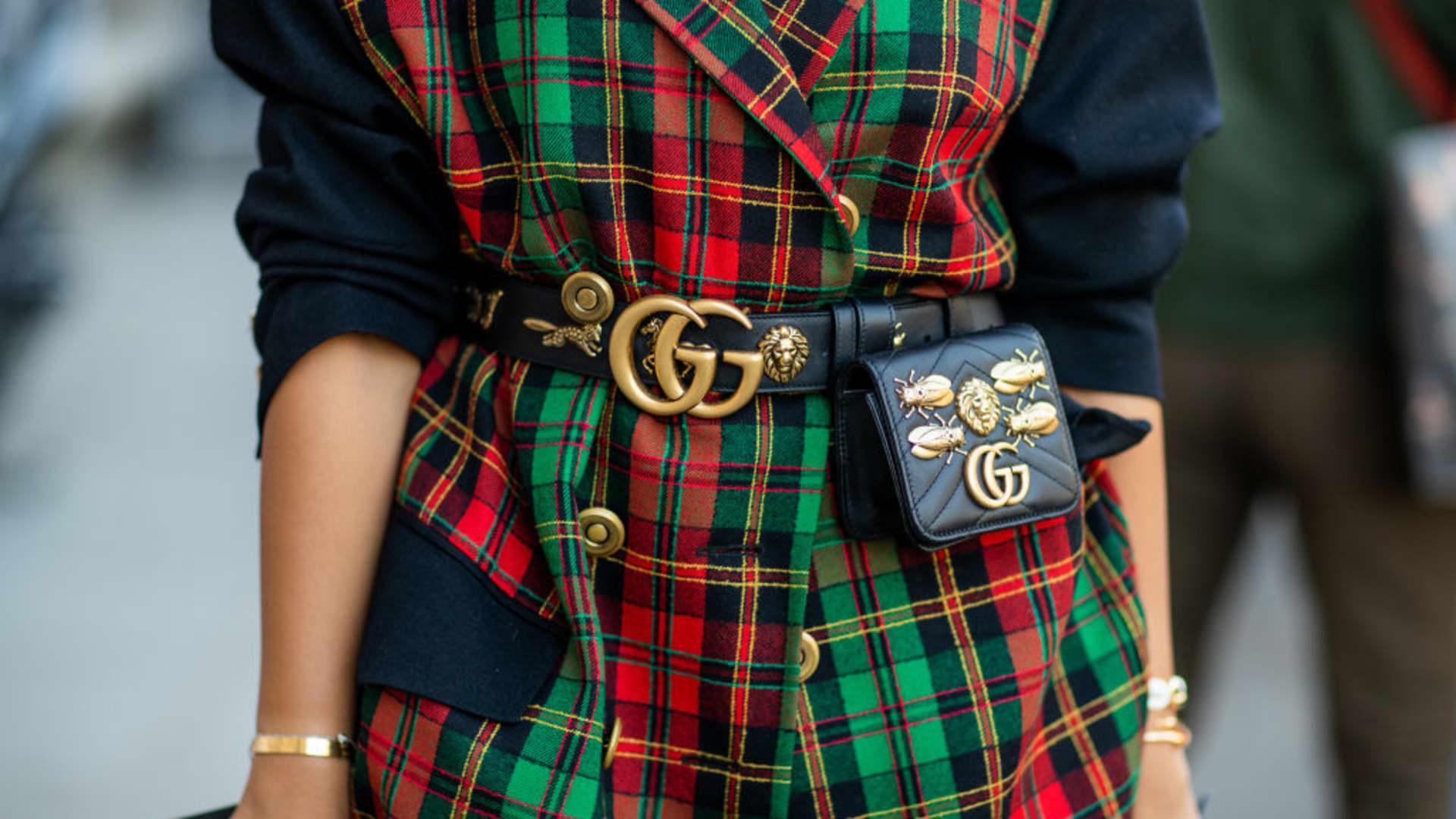
A woman wearing a Gucci belt and bag is seen during Paris Fashion Week in September 2018
Christian Vierig | Getty Images
Kering said Thursday it aims to double profitability and revive its flagship brand Gucci as it announced its highly anticipated strategy to get the company back on track after a year-long luxury slump that hit it harder than its competitors.
CEO Luca de Meo announced the strategy seven months after taking over the reins, during which investors’ optimism has mounted that he’ll be able to turn the legacy conglomerate around.
“In a nutshell, a model that worked for a decade, is no longer effective for us,” he said during the company’s Capital Markets Day in Florence on Thursday. “Growth will come first from gaining share, restoring pricing power, and executing better than our peers.”
Investors reacted with skepticism, with shares falling as much as 5% early Thursday before paring losses to trade 4.3% lower as of 8:30 a.m. ET.
Luxury stocks performance over the past 12 months.
The strategy, dubbed “ReconKering,” includes more than doubling the company’s 2025 recurring operating margin of 11.1% while boosting its return on capital employed to over 20% in the midterm.
Kering also aims to refurbish or relocate two-thirds of its Gucci store network, reduce selling space by 20% and outlets by a third to achieve a doubling of its sales density by 2030. It also aims to reduce overall inventory by 1 billion euros ($1.18 billion) over the next 12 months.
It is also targeting additional revenue from leather goods of 1 billion euros by 2023, as well as 600 million euros from ready-to-wear and shoes, and 500 million euros from jewelry and watches.
De Meo has already taken steps to reduce debt at the company, including by completing the sale of its beauty division to L’Oreal in March for 4 billion euros in cash.
The momentous task of turning around its moneymaker Gucci remains a key issue.
“One key question is how quickly Gucci can regain centre stage and return to healthy growth, as the luxury sector continues to face a mix of structural and cyclical headwinds,” Citi analysts said Thursday morning.
The Gucci problem
Gucci, which makes up the bulk of Kering’s profits, is a key concern for shareholders.
On Tuesday, Kering reported the 11th straight quarter of organic sales decline at Gucci, and said sales had been hit by the conflict in the Middle East.
Kering, like many of its luxury peers, has seen years of contraction following a boom that ended in 2022. Demand spiked during the Covid-19 pandemic, leading to price hikes that eventually alienated customers. Coupled with weak demand in China, formerly one of the sector’s main growth drivers, businesses suffered.
Gucci has “lost some of its shine,” de Meo acknowledged Thursday.
“Our priority is to make Gucci unmistakable,” he said. “Not louder, not more complex, simply unmistakable.”
“This work has already begun. We are refocusing the brands around fewer narratives, but narratives that are sharper, stronger and more coherent,” he added.
Gucci’s recognizability is one of its greatest assets, he said, but that doesn’t mean “covering the world in GG.” Being “unmistakable” can also be quiet, discreet, and refined, expressed through craftsmanship and identity codes that are “immediately Gucci,” he said.

The luxury giant is aiming to double the contribution of leather goods and handbags by 2030, to 20% from 10% today. “We will do it without losing… our fashion authority, because that Gucci heritage and fashion must coexist,” de Meo said. “Restoring desirability requires also restoring a strength in our product offer.”
Kering has said that it needs to not only improve the performance of Gucci, but also reduce the group’s dependence on the brand by boosting other brands like Yves Saint Laurent, Bottega Veneta and Balenciaga.
The company wants its over 10 different brands to leverage their distinct identities, while still scaling synergies across the group.
For Saint Laurent, that entails doubling down on its “fashion authority” and “desirable silhouette,” while reinforcing its men’s offering and focusing on Asia.
Meanwhile, Bottega Veneta should be the group’s “emblem of deep luxury,” and Balenciaga its way to attract the younger generation.
Kering has a relatively successful track record of turning brands around over the past two decades, particularly Gucci and Saint Laurent, while enabling smaller, niche, and historically unprofitable brands like Bottega Veneta and Balenciaga to emerge as sizeable, profitable, and culturally relevant, noted the Citi analysts.
“That said, luxury brand turnarounds have become more complex, slower, costlier, and far less public‑market‑friendly than in the past,” they added. “The sector’s cyclical pressures have also intensified with double-digit sales decline in the Middle East ~(5% of sales) and disruption to global tourist flows.”